Is This a Mirage or What?

I have never studied psychology (although in my family, the practice could prove itself to be quite useful), so I’m not sure if what I’m about to describe has been codified or not. Lately, I’ve been seeing more BW/WM or WM/non-black male couples in the street, and I’m wondering if it’s because I’m more aware of the subject because I talk about it on this blog. If anyone has made a study of this sort of thing and can come up with a name for ‘invoking examples of a reality after discussing the topic’, then I’d like to know. I wonder if this is happening because these couplings are becoming more frequent, or because I’ve noticed it more. If it’s the former, then a sociologist might find that interesting. If it’s the latter, then maybe it’s happening because I’m blogging about the subject. (Almost like the time I caught a caucasian then-boyfriend looking as Asian porn Web sites and gave him a really hard time about it. After that, it seemed to me like the city’s streets were strewn with white guys who were either hand holding, married to or burbing babies with Asian women — or looking to do so.) 

These couples are not doing anything special. They are just waiting on subway platforms or navigating dense rush-hour crowds in downtown Manhattan. Or angling their digital cameras through holes in the fence surrounding the WTC construction site, as their biracial kids waiting patiently in their strollers. I will say that I noticed these folks during particularly hot days, when the Northeast was in the grip of an icky heat wave. So, it could all just have been a series of heat-induced hallucinations.


I Blame the Melanin

Hey blog readers, it’s been a while.  I blame the pregnancy hormones — not the baby directly, mind you! Baby Silk is the best thing that’s ever happened to me. I can’t express how much I ran around my bedroom like a NUT when the EPT test screen read: ‘pregnant’. It was like opening the most amazing Christmas/Birthday gift EVER. I think I’ve just about adjusted to the hormonal changes that keep me sleepy or itchy or bloated or craving thick slabs of crispy bacon. All the time.  

Anyway, on a day that I went to a doctor’s office for an important baby-related sonogram, Hubby called to tell me about this column in our local newspaper, about a profoundly gifted youngster named Dakota. He gets a mention here because his parents fit the theme of this blog. Imagine being so smart — no, brilliant — that grownups have a hard time figuring out what to do with you. Where does that sort of intellectual ability come from, anyway? Being a person who cannot get through the day without a saucy quip, I say it’s the melanin. 

Despite the family’s difficulties, I’m sure that things will eventually turn out very well for young Dakota. And his sister Jewel. 

Dakota started college at 9, in Colorado, one of many stops the Killpacks made searching for a school for him. They moved to New Jersey, primarily because of the willingness of Middlesex to take Dakota and accept credits earned elsewhere.

“We didn’t plan on this kind of life,” says Patricia. “We thought that, when it was time for him to go to school, he would start kindergarten like everyone else.”

But, of course, most kindergarten children were not — as was Dakota — reading Alex Haley’s “Roots” for enjoyment.

The article was published on June 2, which means I should have posted a long time ago!  So sorry folks, but the office visit distracted me in a big way. Once I looked at those images of Baby Silk on the screen, stretching, curling up, opening her/his mouth, putting her/his thumb in her/his mouth, I was a complete and certified goner.  Besides, which would you rather have? A mother-to-be constantly gushing about the most beautiful, sweet, adorable baby-to-be, or a blog about interracial dating?  

Thought so. Now let me try to put Baby Silk in perspective and get back to writing about my 1,000 opinions about the world! 


Who’s Holding the Purse Strings Anyway?

So there I was, merrily working away in the office when this landed in my ‘Inbox’. We’ve all seen this sort of discussion aired in one way or another on talk shows, in magazines and through any other medium that attracts women. You all can probably guess why I posted it here: are the same dynamics at work in BW/WM interracial relationships?  I would think that since a lot of black women in this group met their husbands at work, then there is a chance that she was his supervisor, or was in a higher income bracket than he. 

It certainly was not the case with me and Hubby, I assure you.  Once while we were still dating, he inadvertently put me to shame. He told me what he had saved that year — as in banked, put away, stashed, etc. — and the figure represented more than my gross earnings in the same year!  Now I knew I either had to:

a) leave my line of work

b) shake down The Man for a raise

c) change jobs 

This press release certainly does not apply to me, but I want to hear from the sisters out there with bank. Discreetly, of course. Do you out earn your guy? Did your high salary somehow act as a turnoff to the brothers? This informative piece comes from the women at BettyConfidential.


PALO ALTO, CA, May 20, 2008.  It’s what women have strived for since that sweltering July day in 1848, when Elizabeth Cady Stanton and four of her girlfriends gathered over tea to plan the first Women’s Rights Convention, held just one week later. And it’s what women had in mind when they started burning their bras and stopped shaving their armpits in the 1960s.

We’re talking about the title of Primary Breadwinner. Okay, maybe “equivalent breadwinner” was more the goal, but while much has been reported on the increasing number of women in the breadwinner role, little light has been shed on the accompanying social impact – particularly amongst women who hold the title and how it’s affected the state of their unions. Until now. A survey conducted last month by BettyConfidential.com revealed that most women in this role are simultaneously proud of themselves and resentful of their husbands.

“Perhaps because of what we’ve witnessed in popular culture – with couples like Reese Witherspoon and Ryan Phillippe – I think people suspect that a woman outearning her husband is a catalyst for tension in the marriage,” said BettyConfidential.com editor, Nicole Christie. “Our survey reveals that outearning one’s husband is a blessing – less financial worries, a sense of pride – but also a curse, creating a greater pull of work versus family and a gap between husband and wife that’s difficult to bridge.”

As of 2005 (when data was last compiled), the Bureau of Labor Statistics reports that roughly one-third of women have gone above and beyond by outearning their husbands. This figure is up 28.2 percent from a decade earlier – and has even resulted in a growing trend of women paying alimony to their ex-husbands (“Men Receiving Alimony Want a Little Respect,” Wall Street Journal, April 1, 2008).

A 43-year-old investment banker sees both sides of the woman-as-breadwinner coin in her marriage. “I have financial independence that my mother never had,” she says. “But I do resent my husband because there are so many household chores, community events, and school events that the ‘woman of the house’ is expected to do.” She finds it helpful that her husband works full-time as opposed to staying home, yet says workmen at the house won’t discuss repairs with her and that financial consultants defer to her husband, assuming he is the breadwinner and household decision-maker.
The survey also found that, indeed, marriages sometimes can’t withstand the pressure of a woman in the top earner spot. A 40-year-old marketing strategist from Monterey, California says her marriage crumbled as a result of her breadwinner status – not for monetary reasons, but because of the discrepancy in life approaches. While her ex-husband is an Ivy League-educated Wall Street attorney, she found him lacking as a partner in their marriage.

“He came from a very well-off family who put him through college and law school, while my parents forced me to pay my way,” she explains. “I think this is what allowed me to achieve great success and become the primary breadwinner. But while my ex-husband is intelligent and talented, he lacks ambition and always looks for the easiest route – opting for the shallows while I conquer Level IV rapids. He’s also surprisingly bad with money and didn’t support me logistically or financially through my pregnancies, when I was exhausted from running several businesses. Ultimately, our differences just couldn’t co-exist under one roof.”

At the same time that a woman’s primary breadwinner role tugs at the seams of her marriage, her ability to care for herself and her family affords a freedom not known by previous generations. “You have total independence and can want to be in a relationship rather than need to be,” says Maria Ricca, a 53-year-old program manager. Adds theMonterey marketing strategist, “I think all women need to at least prepare to be the primary breadwinner. The unhappiest women I know are those who rely on their husbands to completely supply and manage their financial lives. Why chance it?”

Is That How You Date a White Guy?

In a previous post, I mentioned the release of ‘Kinky Gazpacho’ a memoir from professor and writer Lori L. Tharps.  I had put off starting the book because I was finishing another title at the time.

The wait was worth it, and I urge all of you to pick up a copy. It’s not because we all share a common interest in interracial relationships, or that this book ought to be filed on the ‘interracial reading’ shelf of your personal bookcases. Tharps’ story and her writing brings a refreshing dose of levity to an issue that all too often becomes ensnared in militant politics. There are no ‘mammies’, no ‘haters’, no white boys with black girl fetishes or any of the other nonsense that can muck up attempts by white/Hispanic/Asian men to get to know us better.  Her style is open, personal and very, very funny.

Quite simply, ‘Gazpacho’ comes across as a pure-hearted account of Tharps’ attempt to find her place in the world and explore her love of international happenings. The chapters about her childhood in predominantly white Milwaukee are insightful and disarming to say the least. I was incensed after reading that she got to college, sought out other black kids in an attempt to connect with her black heritage and got a mean-girl brush off. I’m at the part where she’s planning her wedding to Manuel, whom she met in Spain.

While reading ‘Gazpacho’ it occurred to me that it wasn’t primarily about dating interracially. It struck me as an account of someone who thinks internationally. It also got me to thinking that although America is a very diverse country, technically speaking, all the wonderful nationalities and ethnicities represented here are still so very insular that we have no idea as to how to interact with each other. Think about it: how often does the average person have an individual or family of another race, nationality, native tongue or religion sit down to a casual family dinner?

And not only that, but why is it that so many black folk (yes, I’m calling you out) think you have gills on all three of your heads if you carry yourself with some articulation, polish or even if you wait until after marriage to start having kids? Do you know how many times some knucklehead from the projects asked me ‘why you ack white?’ UGH! But that’s another post. 

And let me be fair. Black folks are not the only ones who exhibit the human tendency to stick together, deal with each other in our mother tongues and imitate each other. That tendency is so strong that in some communities in the U.S.A., you have to order a cup of ‘café con leche’ to wake up in the morning, not coffee with milk. In some predominantly white communities, you might be hard pressed not to find a bottle blonde.

There really is no required attitude or formula that one has to follow before falling into an interracial relationship, except of course, for having an open mind about the world. And by that I mean a mind that isn’t polluted with the idea that one of the benefits of marrying a white man is that your children will ‘turn out with good hair’ or ‘pretty skin’.  A person needs to enjoy travel, trying out different foods, talking about all sorts of interesting topics. They need to see life as an ever-changing web of friends, rather than living within rigid social boundaries. 

Which Couple Is Interracial?


Michelle & Barack Obama. Halle Berry & Gabriel Aubrey. Both of these couples are attractive and popular for various reasons. You know them on sight. Michelle and Barack are the political ‘power couple’. Between Halle and Gabriel’s genes, I’m sure we’re all waiting to see photos of the world’s most amazingly beautiful baby. 

Both couples have something else in common. One of the partners is biracial, with black and white parents, while the other is of one race. Yet most people would refer to Halle and Gabriel as an interracial couple, while simply describing Michelle and Barack as a black couple. If you dwell on these things as much as I do, that doesn’t quite sound right. The racial balance is exactly the same within both the couples, but that balance is interpreted quite differently depending on whether the biracial person married someone who is white or black. That seems like arbitrary reasoning, to me. 

Why do we do that? I include myself in that group because I have to admit, I have a tendency to look at biracial people and, if it seems like their appearance reflects one parent’s ancestry more than that of the other, then I describe that person accordingly. Sure, Barack Obama is mixed, but on sight, I describe him as a black man, and only secondarily as mixed or biracial.  Maybe this is not exactly wrong, but it’s imprecise and I can understand how annoying it must be for biracial people, especially if they have a strong emotional connection with their white or Asian or Hispanic family members. I mean, it wouldn’t make sense for someone to call Barack Obama white, because his father was Kenyan. 

Mental note: stop forgetting to call biracial people biracial. They are not black, in the sense that their ancestry is not completely or 90% African. Which brings me back to my original question: why call Michelle & Barack ‘black’ while sticking to ‘interacial’ for Halle & Gabriel? Maybe we should just call them attractive, happy or annoyingly cute?  

One last note: being a news junkie, I cannot help but follow politicians. I wanted to include Adrian and Michelle Fenty on my biracial couple catwalk.  The thing is, Michelle looks like she is of mixed heritage, too. All I’ve been able to find out is that she grew up in Wimbledon, England with her Jamaican parents.  Actually, looking at a person with a lighter complexion and Jamaican parenthood, at least in my mind, suggests that someone in her lineage is or was biracial. You know that we Jamaicans are ‘good for that’. 


She’s Pretty … For a Black Girl

It was like a modern-day version of the famous Clark doll test from the 1940s. Back in the early 1990s, several of my cousins, a friend Melinda and I were hanging out in my aunt’s kitchen looking at a Victoria’s Secret catalog. That’s what women sometimes do: we page through catalogs of beautifully nipped, tucked, underfed and airbrushed women, and then we judge ourselves harshly by an impossible beauty standard. Or we decide we’re being silly and share a pint of ice cream. That afternoon, though, the conversation took a heated and serious turn.We stopped at a picture of a woman wearing a dark suit (with a low-cut neck line of course, because it was a Victoria’s Secret suit). She had a dark olive complexion, hazel eyes and highlights in her brown hair. The overall effect was that she looked like she was from North African descent, or her parents were from Somalia or Ethiopia, or at least she was of mixed heritage. While we checked out the rest of the picture and read the product information, Melinda blurted out: “She’s pretty, for a black girl.”

Of course, the whole room erupted into chaos. Pretty for a black girl? Ugh! There were so many things wrong with that statement, we didn’t know how to begin upbraiding her. But we did our best!

“So, black women are not normally pretty?”

“That’s the reason black women feel bad about themselves!”

“Whitey did a good job on you!”

Poor Melinda. I’m sure that in her mind, she only meant to pay that model a compliment, but it was clear that there was something in her thinking, and by extension our generation’s thinking, that needed to change. The Clark test said as much about our parents’ generation. In a study that shored up the case for outlawing segregation in American public schools, psychologists Kenneth Bancroft Clark and his wife, Mamie Phipps Clark used identical black and white dolls to gather compelling evidence that “prejudice, discrimination and segregation” (Library of Congress) caused black children to develop a sense of inferiority and self-hate.

One would think that black people had ditched those attitudes back in the 1940s. Yet here we were, supposedly modern black women, facing similar issues. How did Melinda learn to measure attractiveness in dark-skinned women, and why was the possession of light skin a prerequisite of their beauty? That model wasn’t even dark-skinned, but in Melinda’s mind, she wasn’t light enough to be considered pretty outright. Sadly, the prevailing attitude in a lot of cultures around the world, such as India, Latin America and the Caribbean, is that pretty women must have light skin, and if at all possible, narrow noses and straight hair. Sometimes that line of thinking takes a dangerous turn, as people from those cultures treat give darker skinned folks a hard time while revering the light-skin standard. I don’t know if Melinda changed her attitudes in the intervening years after that tumultuous afternoon catalog flipping, because we fell out of touch as we took different paths in life. If I saw her today and introduced her to Hubby, born in Wisconsin to parent of Scottish and German backgrounds, would she venture to remark about the ‘pretty’ children we would have one day — that is, pretty as far as black and biracial goes? Who knows? Maybe she has grown past all that by now.

At this point in my life, I am sure of one thing. I’ll do everyone a favor and steer my future sons, and especially my daughters, away from people who harbor those kinds of attitudes.

No, He’s Not a Stalker

alexanders2.jpgThat man behind the shrub is Michael Alexander and he’s peeking at his lovely wife Bianca. They operate a company called Planet Media Inc., which puts on a weekly television program about environmentally conscious living, plus does planning and consulting work for “green” events. They were featured in an April 2008 feature story in Black Enterprise, about conservation-themed black businesses. Bianca appeared on the cover solo 😦 , but at least her hubby joined her for this beautiful inside picture. (I tried and tried, but I could not resize it any better than this.)

Anyway, the Alexanders are just a sampling of the freshest crop of black folk in the media taking a serious look at environmental issues.  I remember that the character Freddie from the college sitcom “A Different World” was the first black character who was passionate about ‘environmentalism’ ( a relatively new term back then) and other of-the-grid issues. Nowadays, it seems that every sistah and her momma have some understanding, even if it is basic, of the importance of recycling, conserving energy, etc. Even this prime time spitfire, Marshanna from The Bachelor was Miss Earth New York 2007! It’s the first I’ve heard of a green pageant queen. And of course, there is a purpose for singling out Marshanna on this blog.  She’s supposedly still in the running to get a rose from the latest bachelor.  Actually, I hope she’s not the one that the newest bachelor picks at the finale.  This show is cursed and I’m convinced that none of the guys appear on this show to find a wife. They just want to live out their fantasies of having a harem at their disposal. All of the couples—at least the ones where the man does the picking—either break up or fail to get to the altar in a reasonable amount of time. I would not like to see any sister suffer that kind of heartbreak in the national spotlight.

Finally, I want to try to explain why I disappeared for such a long time. Ever since February I’ve been SLAMMED with fatigue. I mean it’s like nothing I’ve ever experienced before. Just can’t get enough sleep. Between that and the other odd symptoms, like nausea, tender swollen boobage, and strange cravings, I think it’s high time I got solid confirmation of what I think is going on here. If there’s any news from the bakery, or our family is expanding, I’ll discuss it in due time.  (Someone put the brakes on the puns!!)

Views from Across the Pond

I’ve always thought that British society was far ahead more sophisticated than ours in its acceptance of interracial relationships. In a small way, I’ve seen this in my own family. Two female cousins, who are sisters, are both married to white men. One of their other sisters dated white men, and they’ve often talked about how IRs are so common, that people scarcely turn their heads to look at those pairings anymore.
Yet it seems like for every bit of social progress we make, there are lingering attitudes and pesky issues that need to be pruned away. For instance, MaMaButterfly2007 mentioned that her mother discouraged her and her sister from getting involved with white men. Could that have been because her mom blamed their cultural/ethnic differences as the cause of their nuptial unhappiness and eventual breakup? That wouldn’t seem likely, because MaMaButterfly2007 mentioned that her father went on to remarry a different black woman, and that they remained married (up until the date of the video). At any rate, I thought MaMaButterfly’s testimonial was interesting, because she mentions several observations about IR pairings that were interesting.

This video clip runs about five minutes.

Jamaicans Are Good For That

One evening, I forget the season exactly, a few of my cousins and I were hanging out in my cousin Laura’s bedroom. At some point, we began speculating about the outcomes of our lives. After Deena got her ‘papers’, she might go on to become a local political power broker; Laura would be a track star; Sharon, a financial whiz. Deena – bless her impertinent heart – said: ‘Silk is going to marry a white man.’

It was unbelievable. Everyone knew I loved to write. Shouldn’t she have built on that and gone for something more fantastic, like me becoming a world-famous author – or something? And what exactly was in my temperament that predisposed me to marry a white man?   

Over the years, I noticed that I got more attention from guys outside my race than from black men. I also noticed that three of my female cousins were married to white men. I didn’t think that any of this was extraordinary, because all the marriages seemed to function like every other marriage I observed, and a couple of my cousins have been married for 30+ years. Marriages built on superficial attitudes about beauty and social importance simply don’t last. But I remember mentioning that little tidbit to someone at work, and she said: ‘yeah, Jamaicans are good for that.’ I didn’t confront her about it, because I realized that she was partially right. If you’ve spent any appreciable amount of time working, living or socializing with a Jamaican, you might have noticed that we are not nearly as opposed to dating and marrying interracially as black Americans. Those are not bragging rights, because Jamaican pop culture tends to cherish light skin. Some people are completely blind to the beauty of a black woman who is not light skinned, and I touched on that theme in the post “She’s Pretty …”. Deena’s pronouncement might have been made in girlish mischief, but put together with what my co-worker said, it almost sounded like a damning confirmation of superficiality.  

So here I am, married to a really nice guy, who happens to be white.  He’s adventurous and personable. His family embraced me and the same is true of mine. After having lived with this guy for some time now, I have to say that my main aversion to the idea of marrying any white man – is that they were boys at some stage. Nose-picking, reptile-catching, running, screeching boys.  The kind that wrestle you for no good reason.  Or drag you down the stairs by your ankles. Or stare at your chest. NOT that my Hubby did all the abusive stuff, but every now and then he shows me that he is, indeed, a guy. Believe me folks; I weighed all sorts of questions before I let him slip the ring on my finger. Where would we live? What kind of spiritual life will we lead? How will the children be brought up and will they be well adjusted and healthy?  (Not, will they have ‘brown’ skin and ‘pretty’ hair?)  Actually, I do have more to say on the subject of what our future children might look like, if we have them, but that is for another post.

At the end of the day, the fact that my heritage is Jamaican, and that Jamaicans are infatuated with light skin was not enough inducement for me to run out and snag the first (actually fourth) guy outside my race that I could find. 

Root for Kaia & Thomas!!

After figuring out that I needn’t actually watch reality TV shows to know what happens (just catch the replays on YouTube or eavesdrop among the honeybees at the office), I haven’t seen an episode of a reality show in years. That might change after tonight. I just glimpsed a preview of an upcoming episode of “Here Come the Newlyweds” and this cute couple caught my eye.

kaiathomas.jpg

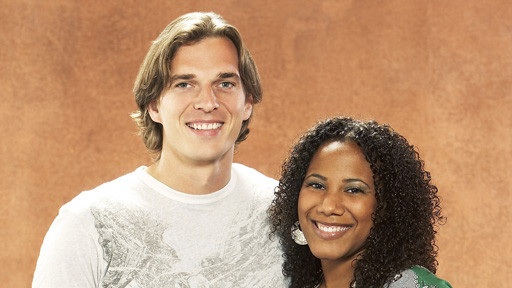
Kaia and Thomas Jacobi hail from Washington, D.C., and they are newlyweds. Read about them here.

I hope they win this contest and snag a beautiful house somewhere in Georgetown, Dupont Circle or any one of D.C.’s other great neighborhoods. Maybe they’ll be adventurous and settle in Adams Morgan. With its gor-geous brownstones, walkability and selection of restaurants, Washington, D.C. is definitely one of my favorite cities to visit.

I am feeling ABC these days. Shonda Rhimes, producer of the hit medical drama “Grey’s Anatomy,” is a black woman, plus there are interracial romances (all involving black women) on the following hit programs: “LOST”, with Rose & Bernard; “Big Shots”, features Katie & James; and the ABC Family network has “Lincoln Heights”, with a couple of high schoolers whose names I cannot remember right now. (Hey, I don’t have cable, so I can’t keep track!) I’m sure that several daytime soaps have features these kinds of storylines, too, but I never keep track of daytime soaps.

This is a refreshing spurt of programming on ABC. How nice it is to see them acknowledge this emerging pattern in American society. I also love the fact that they write the stories without the level of preachy, didactic dialogue that can sometimes drag down love stories. I also realize that this might not assuage some of the annoyance that I’ve seen and heard others express over how networks seem to treat beautiful black women like they are invisible, and rarely put their characters to work in entertaining, classy situations.

Leave the clicker on ABC for a day or so, and you’ll see what I mean. Now, I don’t expect the network to flood the airwaves with love stories between black women and men outside their race, but if they continue a this pace, we’ll have to call it ABC, the Ascendant Black Channel.

No? OK, moving on, then.