My Funny Little Valentine

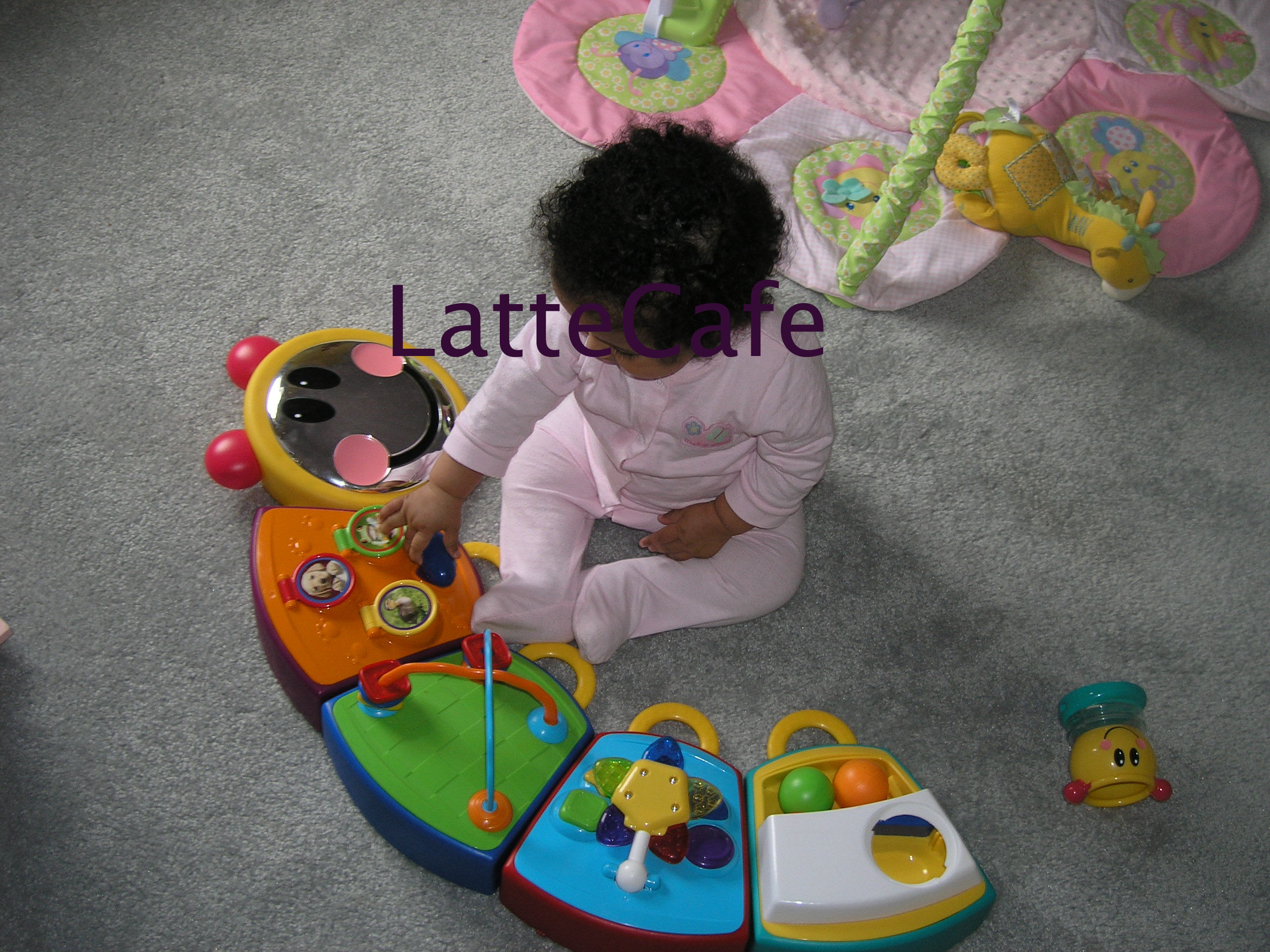
This morning I came downstairs to chop and marinate two chickens for a casual dinner party, when I glanced over at Baby’s high chair. Little Sister had tied two helium balloons to her chair, and propped up an oversized greeting card on the seat. How sweet, I thought, Baby’s first valentine! But it was not to be, because later that morning the balloons scared Baby so much that she ran shrieking away from them in terror!  Her face contorted into the most anguished pout, she scrambled out of my lap and she darted around the table toward the kitchen. She refused to be in the same room with them. We couldn’t believe it.

We rounded up the balloons and tied them to a plant stand in the living room, near the window. On the way out to church, we passed a neighborhood friend and told her about the incident. She says her son reacted the same way to helium balloons when he was very young, too. The day was not a total waste, however. Baby dug the bouquet that Hubby got for all of us. She never once looked at the lilies and roses suspiciously.

Hubby informs me that while he was holding her and trying to raise the blinds in the living room, Baby still tried to get away from him and the balloons! And later in the day, he was showing her around his bookshelf and she recoiled at the sight of a small ceramic clown. I guess this means skipping an elaborate first birthday party for Baby, with balloons and clowns and things was a good idea after all.

This is What Happens When You’re Snow Bound!

Northern New Jersey escaped the blizzard that whalloped the Mid-Atlantic region two weekends ago, but we couldn’t get lucky twice. We had to suffer right along with the rest of the region, which got 17 inches of snow in some places. Anyway, after a day of juggling take-home work and Baby, whose family daycare center was closed, I’m still unable to wind down and go to bed. So I rummaged through a few old digital files, pulled out my YouTube account and blew the dust off of it. Hey, it’s been so long since I’ve posted to YouTube that there is a blizzard of dust on my account! I made some changes to my membership, so I could link more videos to this site.

For those of you who like animals, I found this home movie from a visit to the Bronx Zoo in Summer 2005. That year, Mother and Little Sister visited Hubby and I shortly after we had bought our house.  Little Sister doesn’t appear in this film—otherwise, I wouldn’t have posted it. Don’t tell Hubby I said this, but I think gorillas are amazing and complex creatures, and I wouldn’t mind seeing a few one day—from the safety of a well-armed safari vehicle, of course. (I convincingly project the image of a city girl who thinks nature is terrifying and loathsome, so Hubby would get a kick out of word that I like gorillas.)

Although this winter is not so bad, and I don’t mind the snow,  I feel the dryness and the cold acutely because it’s been several years since I’ve traveled outside the United States. Feeling confined, domesticated and parochial, I believe a visit to Africa sounds romantic and adventurous right now. I would do one of those safaris where you stay in a luxury tent in the evenings and see the animals during the day. Or swing into Capetown and do outdoorsy things during the day while spending the evenings at restaurants, boutiques and cultural places.

Again, don’t tell Hubby I said these things, otherwise he’ll sense an opening, and rather than offering a trip to a world-class city, where I can see stunning ancient architecture and relax at spas, he’ll pursue me relentlessly about the quote-unquote joys of camping in a Nevada desert and skipping hot showers for several days.

A Guy’s (Nostalgic) Take on Things

My clutter bug tendencies have one great benefit—a great collection of old editions of Essence magazine, which published a terrific 25th anniversary issue in February 1995. It led off with a magnificent cover shot of Tyson Beckford embracing a beautiful woman. There was a bangin’ recipe for sweet-potato pie, a luscious photo spread featuring the cast of the old Fox sitcom Living Single in ethnic wedding fashions and a tribute to Bob Marley (whose mother was black and father was white, by the way) written by his widow Rita Marley.

It also ran a feature article about an interracial BW/WM couple. This piece steered clear of discussions about whether black women should open their hearts to the possibility of dating outside their race. There were no statistics detailing the higher rates at which we were dating across color lines. (Blah, blah, blah) In a pair of companion essays, it simply laid out the husband’s and wife’s perspectives of their union. They described their courtship, marriage, parenting a bi-racial child, and the ways in which the social scene in Oakland, Calif., responded to them.

Shimon-Craig—the husband—had a great essay. We don’t often hear from guys on the other side of this issue (probably because they would rather watch old episodes of Lost or 24 than talk about relationships), so his essay provided refreshing insights into the dynamics of their relationship. He talked about why Katrina LaThrop made his heart flutter. I also felt a bit bad for him when he recounted some of the hostile reactions he got from blacks in public whenever the family was out shopping or were trying to enjoy a cultural event. You would think blacks would understand why he and Katrina made a point of educating their son about his mixed heritage. But no. According to his anecdotes, some people went out of their way to be obnoxious and unkind. I expect the social scene in Oakland, Calif., to be much more welcoming for all interracial couples. And I hope he and his wife are still going strong after another 15 years (from publication of that article).

Back in the 1990s, when Susan Taylor was still editor-in-chief and the magazine had not lost its way, it used to run occasional, sometimes annual, write ups about interracial dating. People were just getting around to talking about the issue, and Essence did it’s share to deliver classy, well-thought out discourse on the topic. At this point, I hope that we can talk less about whether interracial dating is alright for black women, and start talking about how, like other married couples, we make it work.

Shimon-Craig

Shimon-Craig2

Shimon-Craig3

Shimon-Craig4

Shimon-Craig5

We Are Gathered Here

It’s hard to believe, but it’s been two years since I started posting my musings, your comments, photos, links and other content related to black women involved in interracial relationships. Do you know what else can be accomplished in two years? You can complete graduate studies, change careers, or start a relationship and a family, depending on how quickly you work. Creative projects like books, albums, plays, movies, etc., can all be started and finished within two years. (I should know. Last fall I read and gave feedback on a friend’s manuscript of her memoirs as a single mom, right before she self-published it.)

But why did I start this project? Several years ago, to be honest, Hubby and I always seemed to be arguing and I was convinced that I made a horrible mistake marrying him.  Sometimes I brooded or complained to my cousins about what I thought were his belligerent, immature, irrational, insensitive, unstable ways. And he must have thought that I was too rigid, emotionally unavailable and loud. I began to wonder if our cultural and racial differences had anything to do with our problems. Why wouldn’t they? Race and culture have powerful influences over our personalities and how we relate to others and how we see the outside world. President Barack Obama was right when he said “change has come,” but for most of us, race will always be a subtext in our interaction with others.  No matter how transcendent an age we think we are living in, race matters on a certain level.

I went looking for advice, quietly, because although I complained to my family about our problems, I rarely breathed a word about my concerns. I found several Web-based initiatives for helping marriages, including Marriage Transformation. It didn’t have a lot of content that addressed my situation specifically, but I bookmarked it anyway because much of the advice, especially guidance that I tried for myself, transcended race and culture. Also, I read an article about a couple, white, that had been married for 75 years! The wife said one of the most sustaining elements of their relationship was being considerate of each other’s feelings. From these and a few other sources, I learned that marriage is a promise to stay. See it through. Slowly, we came to an understanding about his bizarre outbursts and I stopped locking my feelings in a vault.

This is all great, I thought, but what wisdom do interracially married couples have for me?  Maybe people like Alfre Woodard and Roderick Spencer; Shadoe Stevens and Beverly Cunningham; or other famous and interracial couples have touched on this subject, I thought. No such luck. Instead of insight from couples who have been in these relationships for a long time, I found several blogs and one Web site with a chat function, all of which actively encouraged black women to open their minds to the possibility of dating outside their race. Ultimately, I felt that the content on some of those sites were too preachy and overwrought, and I thought the presentation was tacky.

But it wasn’t all a waste of time. The very best blog about black women in cross-cultural relationships was Angry Black Cat, an attractively laid out and dynamic Web site that was created and maintained by an interracial married couple. It was such an interesting concept: a husband-wife team that took up this hobby together and had a great time sharing their common and individual experiences as related to their relationship. The site was loaded with interesting features like well-written posts, podcasts, message boards, videos, surveys and insightful comments from people who seemed reasonable. My favorite feature: the levity. No sniping among visitors was allowed. Jeff and ABC seemed like very personable, energetic people, and for several months, I was hooked on the site, checking it every day for new content. (That was unreasonable. I mean this was their hobby. They had real paying jobs to maintain.)

After a while, my marital problems seemed to fade. But I realized that there were popular conversations going on about relationships like mine, and I decided to be heard, too. Why not? I have wise relatives and friends who have given me a lot of good advice over the years about life, relationships and womanhood. I’ve called a few marriage-related situations right myself, so I thought a blog would be a great place to share some of those opinions and experiences with others.  Gentle readers, you’ve caught me at a great time. I have a young marriage and family, and as we all grow and mature, The Latte Cafe could very well develop accordingly. Even though I had to possess a certain levelheadedness to enable me to attain what I have, I don’t know it all. So I hope that I will enjoy, for the most part,  learning from all of the experiences lie ahead and that you’ll benefit somewhat from what I have to share.

Another ‘Black’ Trend Goes Mainstream

A few weeks ago the Pew Research Center came out with interesting data about married women and their earnings. Apparently, they’ve outpaced their husbands in terms of education and salary growth. That means we are earning more money at a faster pace than our beloved ones, even if the absolute numbers say we still earn less.

The underlying theme, of women gaining economic status in their marriages and presumably their households, did not surprise me. Among blacks, women have always been major contributors to the family finances. My mother was single while she raised me. Even during a brief five-year marriage, she ‘wore the pants’. She earned more money and had a better education than her husband. The same holds true for several aunts, cousins and friends. I told Hubby about my idea to write about this topic for my blog. As always, he downplayed the racial element, saying it’s not just a black experience. Lower-income white women, he said, have probably always contributed to the family’s finances. In a broader sense, all the new research really means is that we are all earning less money. The latter was his swipe at some of our country’s social and tax policies. Sensing a political skirmish, I shifted subjects: What should we make for dinner, dear?

The Pew Research Center’s findings on women bringing home the bacon is the second big trend in the black community that has gone mainstream, if you ask me. The first is single parenthood. I remember being a bit unique among my friends at church and school because my parents had never been married to each other, and my mother raised me without my father. Single parenthood used to be blamed for a host of social dysfunctions. As time passed, I’ve noticed that derogatory terms like “baby mama” or “baby daddy” have become so common that it’s no longer a big deal for children to be born out of wedlock. It really became acceptable as more middle-class and even upper-middle-class white women began raising kids without the man and the ring. I guess we have Murphy Brown to thank for some of that, huh?

I must admit that although I personally have no hang-ups about women with stable professions and finances choosing single parenthood, there are far too many single mothers in the black community. On any given day, I can look around my hometown and the city where I live now and see dozens of underaged girls pushing their kids around in strollers. They are kids themselves, so how can they possibly have enough wisdom to do a good job of nurturing and guiding the next generation of men and women? I don’t know. All I can do is try to prevent that travesty from happening in my family. So with my little sister, who will be 17 in March, I often tick off the only acceptable order in which her life’s milestones should come: degree, job, money in the bank, her own place and then she can have a baby!

Among the Pew Research Center’s other findings:
• Among adults aged 30 to 44 more women than men have college degrees.

• The median household income rose 60% between 1970 and 2007 for unmarried women, but increased by only 16% for unmarried men.

• In 1970, 20% of wives had more education than their husbands. In 2007, that figure went up to 28%.

The One Hundredth Post

While checking the blog stats late last night, I noticed that the Latte Cafe hit an important milestone: The other day I turned in the one hundredth post. That is an important occurrence, but it passed without much fanfare. There was no party, speech or celebratory beverage to mark the occasion. (And the bottle of milk and cereal I prepared for Baby tomorrow morning doesn’t count!) Instead, I went about business as usual, looking for other blogs of interest to black women in interracial relationships, adding another link to the blog roll and scribbling a few ideas for future topics on a nearby notepad.

The unremarkable way in which this event came and went, the ordinariness of it, reminded me of a brief conversation I had with my cousin Melinda a few months ago when I ran into her at Penn Station during the evening commute. I walked over and said:

“Hi Melinda. What’s up?

“I’m going to kill Jeff,” she told me, wagging her head slightly and watching the board for her train. Jeff is her husband of nine or ten years.

“Why?”

“Because he’s a man.”

Poor Jeff had likely incurred Melinda’s wrath by leaving food on the stove overnight uncovered, failing or forgetting to do something helpful and responsible while playing with their 3-year-old son Walt or doing some other typical guy nonsense that no-nonsense women like my cousin find infuriating. I laughed slightly, knowing Jeff would find a way to make amends and live another day.

That is what is so interesting and ordinary about interracial relationships and mixed families—they are just trying to navigate everyday life like anyone else. Hubby and I juggle demanding jobs while splitting the housework, fret about backup baby sitters, do our best to coach my teenage sister to get better grades at school and gossip about our neighbors, many of whom are not interracial couples, but are extraordinarily peculiar! Although relationships like mine are as commonplace as ever, stereotypes about the people involved in them abound and need to be dispelled. So I intend to keep on writing about how I see the world, not casting people and situations in black and white or the rose-colored tint of naivete, but from behind the layered, textured, gray shaded tint of my cross-cultural existence.

Hair-Raising Issues

Every morning and evening a minor skirmish erupts between Baby and me over whether I should style her hair or not.  Baby is now 15 months, and she has never been cool with it, even though her hair is very soft and generally easy to comb. In the past, she would try to squiggle out of my lap, crying incessantly as I tried to part her hair and twist the sections into what I grew up calling ‘Chinie bumps’. (These days, people call them Bantu knots.) Although Baby is biracial, and her hair texture is fine and downy—still very babylike—managing her mane is not a snap. If I don’t twist it or spray some detangler on it occasionally, it will become very knotty.

Hubby didn’t always make it easy. Sometimes he would come into the nursery or our bedroom, just to see ‘what the ruckus’ was all about. Baby can be a real Daddy’s Girl sometimes, so she would occasionally look up at him, pout and squeeze out a huge teardrop or two. And once or twice, she reached her chubby arms up to him, awaiting rescue. He would make comments that made hair combing sound like an ordeal. ‘Oh! Here comes the comb!’ or ‘It’s almost over.’ I would patiently explain that if I didn’t twist her hair at night, then come morning her hair would be twice as knotty and the real battle would ensue!  Despite her protests, and Hubby’s remarks, I kept working on her hair. I began to use a moisturizer from Just for Me, just a dab at night to make twisting it easier or so her brush wouldn’t get snagged in her hair in the morning.

The other day she did the funniest thing on the changing table just before bedtime. After I had lotioned her up, diapered her and tucked her into her pajamas, she rubbed her palms together and ran her hands through her hair! Could it be that she was imitating the moisturizing ritual? Too cute.

Now something has happened to make me worry: her edges are thinning out. At first, I hoped that she was passing through a phase where her hair was changing from slick and downy to thick and wavy. But it’s hard not to notice the change, especially in photos like these.

How long would this hair loss continue? Hubby took up arms against the “chemicals” in Just for Me, going online to research the ingredients and asking me over and over if putting “that stuff” in her hair was necessary. As it turns out, the information he found verified that Just for Me is safe for kids. But I wanted to halt the thinning (and hopefully grow a thick head of hair like her mom), so I went looking for answers. Her pediatrician said she might be passing through a phase, but that we could consult a dermatologist if we were really worried. Another black mom told me that her daughters also had delicate edges, and that sometimes using hair bands and wool hats in the winter also tugging and shedding on that delicate area. I also found an article on the Naturally Curly Web site about common mistakes that women make while managing biracial childrens’ hair. Some of my missteps were in that article, like washing Baby’s hair too often and using mineral oil (initially to clear up her cradle cap) for too long. I re-read the “Just for Me” product labels and sure enough, the moisturizer contains mineral oil. So, I’m now on the hunt for hair care products infused with avocado, olive and jojoba oils, which are also formulated especially for babies and toddlers. I’ll probably end up using Curly Qs’ products, because I’ve seen good reviews about them in a couple of different places. Hubby, bless his heart, remains wary about commercial hair care products for babies. He would probably be just as happy if I let her hair lock up if doing so would ensure peaceful bedtime and morning hair rituals. The only problem with that is—we are not Rastafarians!

And anyway, I think Baby and I have come to a nice understanding on this issue. The other night, after I got her into her p.j.’s, I lay her on her tummy and began to twist her hair. She didn’t try to scramble away or howl for the whole neighborhood to hear. She just lay there quietly while I talked to her, working as quickly and gingerly as I could, until I patted the last twist into place. Then I picked her up, gave her a final squeeze for the day and set her in her crib. She smiled up at me before I walked away and turned off the light. Part of me gloated, saying ‘Ha! Take that skeptical Hubby!’ But the bigger part of me simply enjoyed the ceasefire.

* Quick note: There is a new Web site in the blog roll, called Beads, Braids & Beyond. It follows a mom of two biracial daughters (and I think the mom herself is biracial) as she manages their hair. She is a hairstyling artisan and comes up with quite a few creative looks. (I mourn for my daughter at times. The best I can do at the moment is pigtails, because I’m all thumbs when it comes to cornrows!)

For Richer or Poorer

The people at the National Marriage Project have released their annual State of our Unions report, which monitors the current state of marriage and family life in America. It’s a long report, so I didn’t have time to study the whole thing. But I did page through it, and found a few major tidbits:

• U.S. divorce rates in the country actually fell from 17.5 per 1,000 married women in 2007 to 16.9 per 1,000 married women in 2008 (after rising from 16.4 per 1,000 married women in 2005). This is not surprising, as I’ve seen at least a couple of articles in national newspapers say that fewer couples can afford to absorb the financial fallout of divorce, so more are staying together.

• Newlyweds who take on substantial consumer debt become less happy in their marriages over time. By contrast, new married couples who paid off any consumer debt they brought into their marriage or acquired early in their marriage had lower declines in their marital quality over time.

• Marriage serves more as a bond of companionship whose purpose is to satisfy emotional needs—instead of economic ones. So, marriage is less of a socioeconomic unit in today’s society.

The National Marriage Project  says it’s a non-partisan, non-sectarian group that aims to “provide research and analysis on the health of marriage in America, to analyze the social and cultural forces shaping contemporary marriage, and to identify strategies to increase marital quality and stability.” That sounds like a worthy endeavor to me, although I do have one suggestion for increasing marital quality and stability: tell a lot of these guys to be mature and considerate! Although the Latte Cafe is a non-political blog, I couldn’t resist pointing out some of their conclusions.

I have been married for five and a half years, and although my union is not a new one, Hubby and I have been together long enough to have learned a few important lessons about love and commitment. The first couple of years of our marriage were blemished by what I considered to be immaturity and insensitivity on Hubby’s part, and I’m sure there were many times when he thought I was uncompromising. Whatever the case, everyday life seems to be a lot better for us, as we’ve learned to put a house together, subvert our individual interests to promote the health of the household, and well, to appreciate each other more. I’m sure that a lot of the information in this report will affirm what we already know about marriage. There is nothing astounding, for instance, in the assertion that people get married these days more for companionship and less for economic reasons. But it’s nice to know that serious scholars are interested enough in the institution and to make a serious study of it. Marriages everywhere would be stronger if the individuals involved took the same approach to their relationships.

One Test We Cannot Afford to Fail

Ever since I got the typical trappings of middle-class, married life—the house, the cars and the kids—I’ve been more pre-occupied with money. How do I acquire enough of it to live comfortably while giving to charity, saving for various future expenses and investing? Apparently, there is a trade group out there that is interested in how much Americans know about money, and whether we are savvy enough to make the right moves concerning our finances. Judging by the results of their survey, we are way too ignorant on this subject. Read ’em and weep, folks.

Although the survey pool was controlled to represent all demographics in the United States, it got me to thinking about Black women in particular. More than any other group, I think, we need to be sharp about money matters. Most of us are single, and are raising children, too. Who’s going to be there to ensure that we enjoy comfortable and dignified retirement years?  I don’t know the answer to that. But I do know that before we can each craft our individual plans for the future, we need to know where we currently stand.

Americans Nearly Flunk Financial Literacy Test – FOXBusinesscom

Posted using ShareThis

Around the World on Christmas Day

Our house is going to be buzzing with activity today, as Hubby and I host the Christmas feast. Our family is multi-cultural, with Jamaican immigrants and second-generation Americans on my side and the two white guys who were brave enough to marry into our raucous clan. There is Hubby, of Scottish and German descent and my cousin Melinda’s husband Jeff, who is French-Canadian. With all of these influences, our Christmas dinner will be a culinary tour of the Commonwealth and Europe, plus whatever else this adventurous lot can conjure up. We are roasting two Long Island ducks, seven pounds of ribs and brewing about a gallon of sorrel. Aunt Mary is bringing escovitched fish, and her daughter Nia is baking a beer-marinated ham. Melinda is bringing roasted veggies and egg nog. Oh! And Aunt Mary is also bringing black cake. (This feast is going to exact a steep short-term price, i.e. serious gym and purging rituals.)

And because I had to be all Type-A about things, we’re skipping the stocking stuffers. Instead, we’ll be putting treats into Victorian-esque paper cones and hanging them from a seven-foot balsa tree. Each cone will be stamped with a guest’s name on it, so they can pick through the boughs, probably while balancing Melinda’s egg nog, to find their cone.

I can count up to five interracial marriages in my family (including extended family), and all involving the women. As far as I know, all the married men in my family chose black women as wives. Strangely, I don’t think that trend makes us special. I’ve never seriously asked myself why that has happened. Perhaps I feel really comfortable about our cultural makeup, because I’m used to being in very diverse social surroundings. I’ve lived in Northern New Jersey almost my whole life, and here  you can’t move this way or that without practically tripping over people from far afield. It’s practically Queens over here! Naturally, all of these people living, working and playing right next to each other will occasionally intermarry. It would be more unusual—and suspect to some—if cross-cultural pairings rarely or never happened.

Well, Hubby and Jeff fit right into our family. Melinda and Jeff have such an irreverent zest for life that I call them Mad-and-Cap. And Hubby’s first-child seriousness foils my spacey only-child tendencies (a long story for another blog). And our family loves both of these guys, so Melinda and I had better take good care of them! Today we’ll underscore our domestic felicity with a relaxing Christmas dinner over fine china laden with goodies of every kind. And then we’ll dissolve into generally silly and uproarious behavior. Merry Christmas everyone. I’ll try to post another couple of entertaining updates to get you through the rest of this holiday season.